
Site management for motorhome sites: power, water, booking and card payment without on-site staff
EPSIA developed a software platform for the automated management of motorhome sites for Modusan GmbH, Berlin. At each location, a local controller links booking, card payment and receipt printing with power and water pedestals, showers, access points and other field devices.
Guests can book, pay for and use their pitch and utilities themselves. Locations with different equipment use the same software and are adapted to their existing hardware through their own configuration. The system has been in use at seven locations since the beginning of 2026.
- 7locations with the same software and location-specific configuration
- 84sockets with consumption-based billing
- 80pitches bookable automatically
- 1Modbus line for the field devices of a location
The case study follows the project in seven steps: assignment, system design, power and water, booking and payment, configuration, operation and result.
1 Assignment: Utilities and billing without permanent on-site staff
Operators of motorhome sites want to offer power, water and other services without having to keep staff on site permanently. Conventional solutions often rely on coin-operated machines or require manual steps on site.
Modusan develops and manufactures utility pedestals including their electrical equipment. In 2024, Modusan commissioned EPSIA to develop common control software for the sites.
The aim was a software platform that can be used at different locations with whatever hardware is installed there. Development was initially carried out on a time-and-materials basis in several clearly defined packages.
2 System design: One local controller runs the location
Each motorhome site has its own local controller based on a Raspberry Pi running Linux and the EPSIA platform iSDK. The controller manages the local booking database and executes booking, billing and switching logic directly on site.
This keeps the core functions of the site available locally; individual switching and booking operations do not depend on a permanent connection to a remote server.
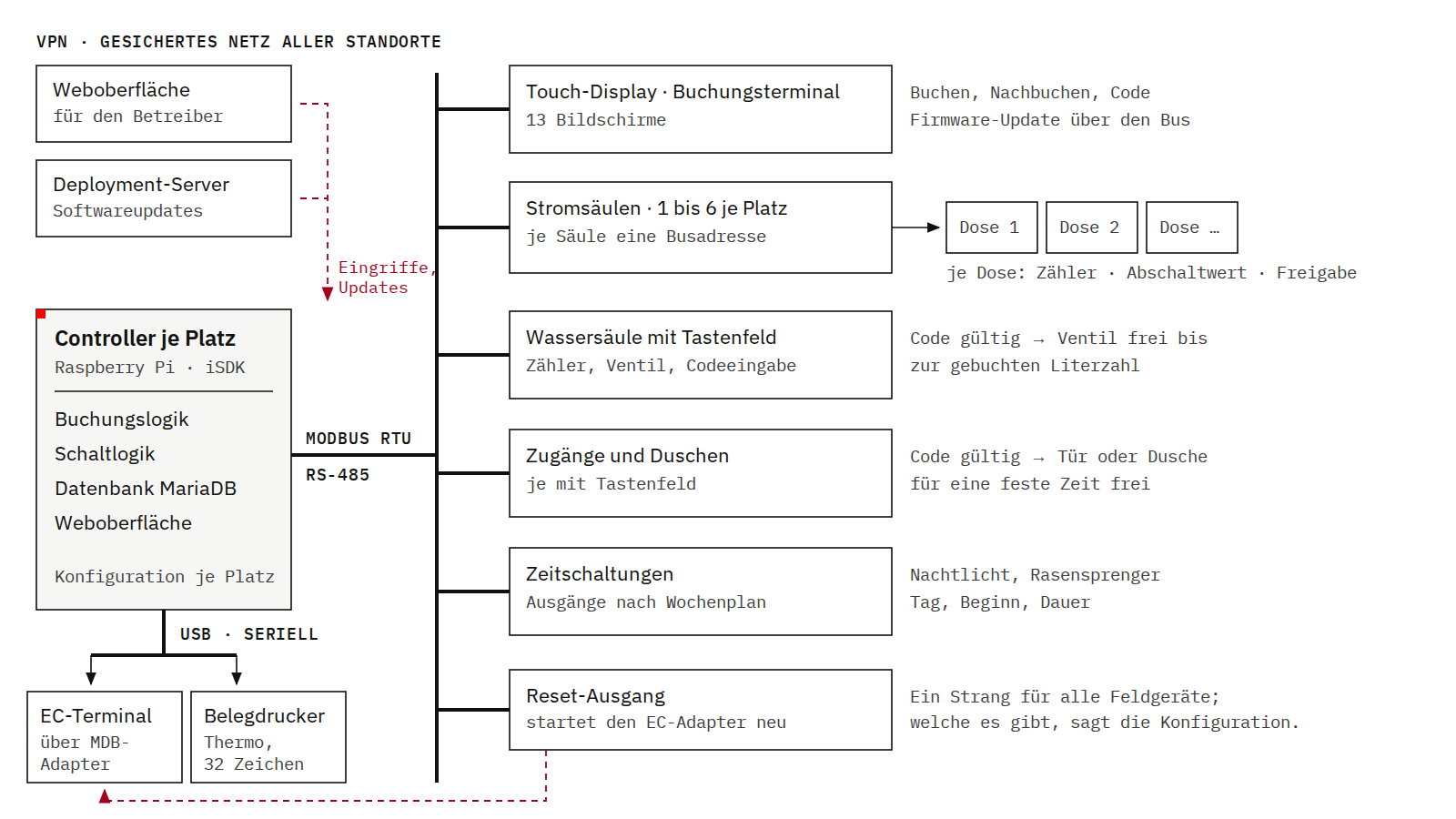
The system connects a range of components:
- Controller
- Raspberry Pi with Linux, iSDK and a local MariaDB database. Separate software modules for each device type poll and control their devices cyclically.
- Fieldbus
- Modbus RTU over RS-485 connects power and water pedestals, keypads, access points, showers, timers and the booking terminal.
- Booking terminal
- A Modbus-capable touch display shows 13 operating screens. The controller determines the sequence and content; new display firmware can also be transferred over the fieldbus.
- Payment
- A card terminal is connected via an MDB adapter. If the controller detects a fault in the adapter, it can restart it through a switchable output.
- Receipt printing
- A thermal printer is connected to the system via a serial interface.
3 Power and water: Providing booked services automatically
The software links a booking directly to the technical services at the pitch.
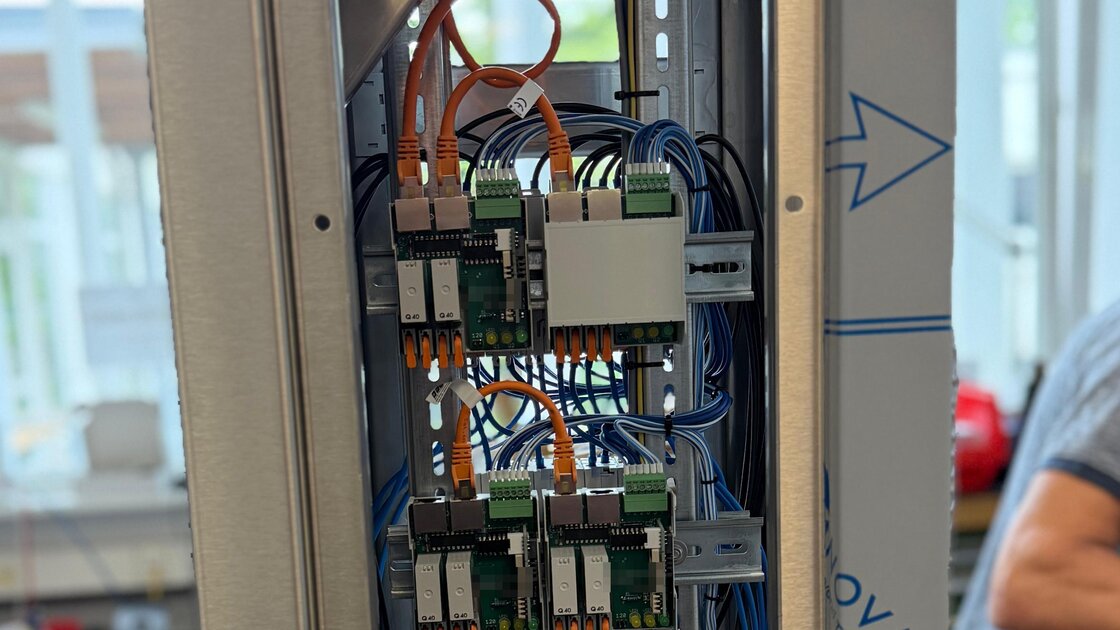
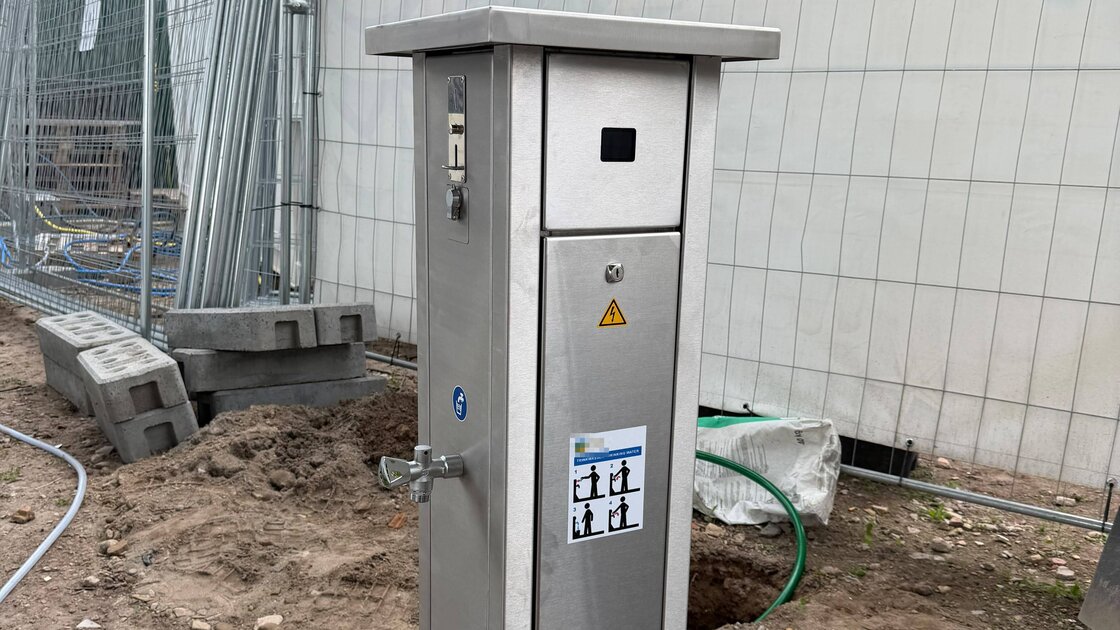
Each socket on a power pedestal reports its current energy meter reading. When a guest books a certain amount of electricity, the controller calculates a cut-off value from the current meter reading and the purchased amount of energy and enables the assigned socket. Once the booked amount of energy has been used, the supply is switched off automatically.
The software also assigns the socket. For each pitch, the controller knows which power pedestals and sockets can be reached and assigns an available connection. The pedestal and socket number are printed on the receipt.
For water, showers and access points, the guest uses a personal access code. The controller checks the authorisation and enables the service according to the booking – for example water up to the booked number of litres, or access for a defined period.
Time-controlled functions such as lighting or irrigation can also be controlled using stored weekly schedules.
4 Booking and payment: From the terminal to checkout
The entire booking process can be completed on site without any intervention by staff.
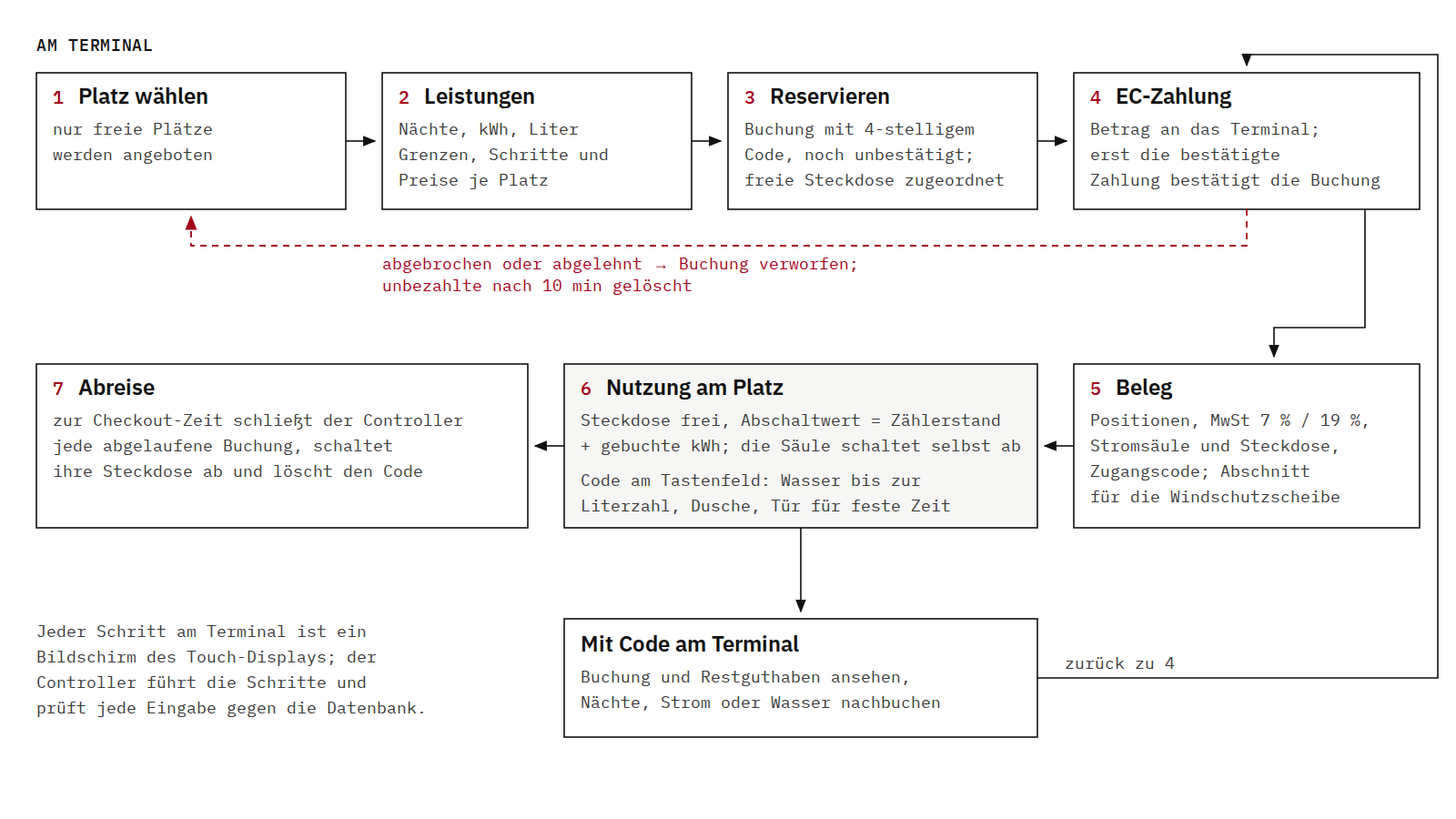
The process covers:
- Booking
- The guest selects a pitch, length of stay and additional services such as power and water. Prices, limits and available booking steps come from the local database.
- Payment
- The controller sends the total amount to the card terminal. The booking only becomes binding once payment has been confirmed. Unpaid temporary bookings are discarded automatically after a defined period.
- Receipt
- The thermal printer produces a receipt with the booked items and the tax rates shown separately. It also shows the assigned power pedestal and socket and a four-digit access code. A separate section can be displayed visibly in the vehicle.
- Extending a booking
- With the access code, the guest can call up the existing booking again, check the remaining credit and book further nights, power or water.
- Checkout
- When the booking expires, the controller closes the session, deactivates the associated utilities and removes access codes that are no longer needed.
5 Configuration: Different locations with the same software
The seven locations differ considerably in size and equipment. A location can have between three and twenty pitches, one or more power pedestals, different numbers of sockets and, optionally, access points, showers, water supply and time-controlled functions.
These differences are not handled through separate software versions. Each location has its own configuration that describes its technical equipment.
This includes, among other things:
- pitches and their assignment to utility points
- power pedestals, bus addresses and sockets
- assignment of reachable sockets to individual pitches
- water points, access points and showers
- time-controlled functions and weekly schedules
- services offered with prices and tax rates
- operator details for receipts and billing
A setup tool generates the data required for each location from this configuration. The control software itself remains identical at all locations.
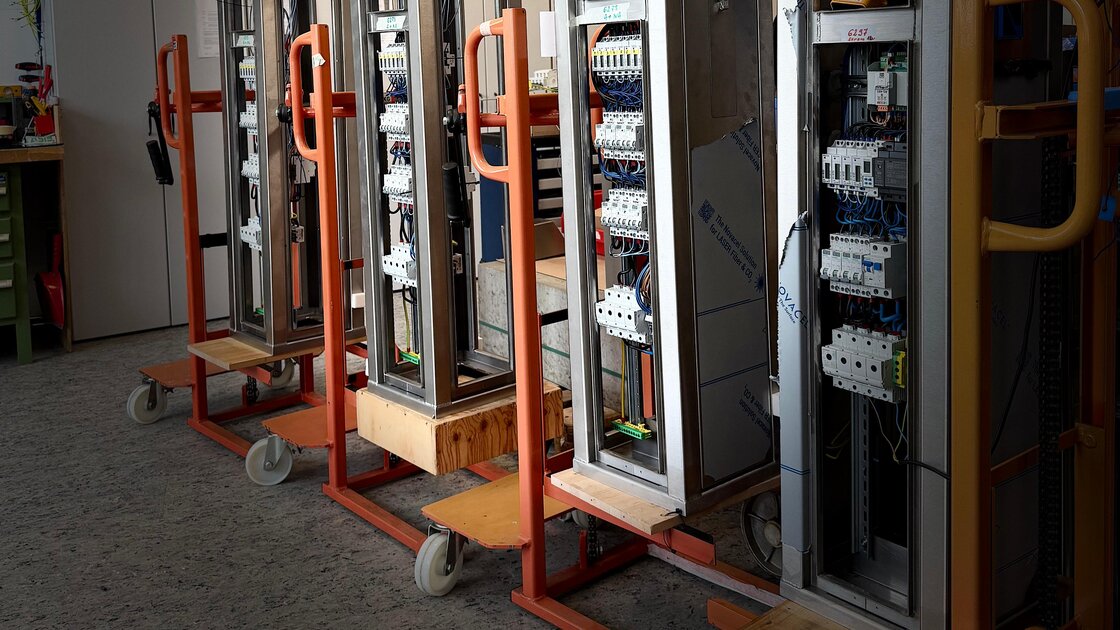
6 Operation: Supporting seven locations centrally
The local controllers can be reached via secure network connections. A web interface gives the operator a central overview of locations, pitches, utility pedestals and sockets.
Depending on their permissions, users can create or end bookings, adjust prices and check printer and payment functions, among other things.
New software versions are distributed to the individual locations via a central deployment server. Control of the field devices and the local booking logic remain on each controller.
7 Result: Seven differently equipped locations with the same software
Since the beginning of 2026, the site management system developed by EPSIA has been in use at seven locations in Germany.
- In total, the software manages 80 pitches.
- 23 power pedestals with 84 sockets are integrated into the system.
- 7 water pedestals are connected to the local controllers.
- Guests can book and pay for their pitch and utilities themselves.
- Electricity is controlled on a consumption basis via the amount of energy actually supplied.
- Different location equipment is handled through configuration.
- All seven locations use the same software base.
What does this project stand for?
The project shows a system with a hardware connection outside classic mechanical engineering. EPSIA combines local field devices, booking logic, payment, receipt printing, data storage and central management into one software system.
The software is not hard-coded for a single location. New locations with different equipment can be integrated into the same software platform through their hardware and service configuration.
This turns a custom control system for a single site into a reusable platform for several locations.
How long did it take until the system went into use?
Modusan commissioned EPSIA to develop the control software in July 2024. Development was carried out in several packages.
In 2025, the booking and payment process was developed further and the user interface was revised, among other things. Since the beginning of 2026, the software has been in use at seven motorhome sites.
How does a project with a hardware connection start at EPSIA?
A project with a hardware connection can start at EPSIA with an architecture review at an agreed fixed price. EPSIA analyses field devices, communication paths, data flows, software components and the requirements for later operation.
The result describes the components needed, how they work together and a sensible order for implementation. On this basis, a functional specification and a fixed-price offer for the subsequent development can be prepared.
More about this service under Software development for systems with a hardware connection.
Key facts
- Customer
- Modusan GmbH, Berlin
- Service
- Hardware-related systems
- Industry
- Utility technology and digital infrastructure for motorhome sites
- Period
- since 2024, in use at seven locations since early 2026
- Technology
- C++, Qt, iSDK, JavaScript, Python, MariaDB, Modbus RTU, RS-485, MDB, Raspberry Pi, Linux, WireGuard.